
What Prince Rupert is for
Prince Rupert is the closest North American container port to Asia and exists almost entirely as a rail gateway: it has essentially no local consumer market to serve.
How cargo leaves the gateway
It is served by a single railway running east, which means practically every container that lands leaves by train rather than by truck.
How containers actually move inland
Canadian container gateways are unusually rail-dependent. A large share of import volume leaves the terminal by train rather than by truck, moving to inland terminals before it is ever handled locally. That changes what tracking means: the useful question is often not when the box was discharged but when it was assigned to a train and when it reached its inland destination, which can be a considerable distance away.
- Rail carries a large share of inland volume from the terminal
- Inland terminals, not the seaport, are where many containers are collected
- Cross-border moves into the US add a customs step to the inland leg
- Local drayage serves the port city rather than the whole catchment
Where free time is won or lost
Because the inland leg is usually rail, the exposure often shifts away from the seaport terminal and toward the inland facility where the container is finally collected. Storage terms can apply at both ends, and the clock that matters may not be the one at the port. Confirming which facility currently holds the container is the first step in knowing which terms apply.
- Storage terms can apply at the seaport and again at the inland terminal
- Rail assignment, not discharge, often sets the practical timeline
- Equipment detention continues until the empty is returned
The Prince Rupert detail teams miss
There is no meaningful local drayage option. If a container is at Prince Rupert, its next real event is a rail movement, and the inland ramp is the arrival that matters.
Tracking a Prince Rupert container in CargoScope
Add the container, Bill of Lading, or booking number once and the arrival, discharge, availability, and outgate events arrive on a single record, with ETA changes kept beside the milestones they affect. One Tracking Credit covers the shipment through its full lifecycle.
What you'll see in CargoScope
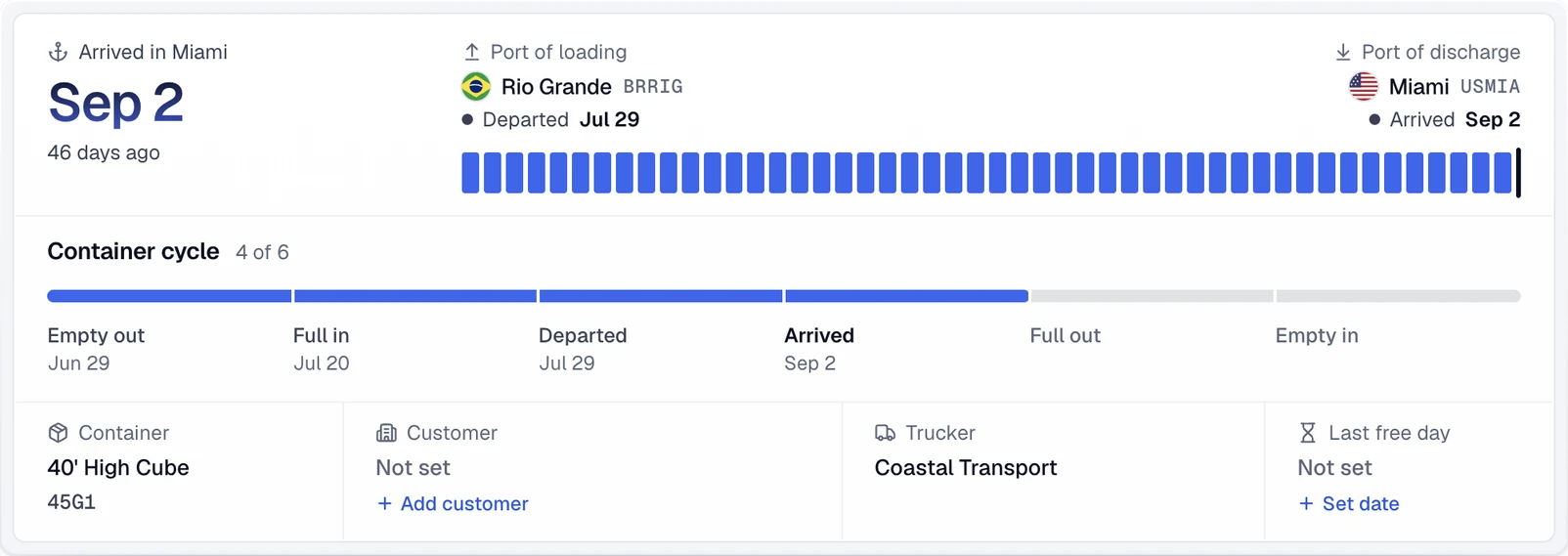
A container discharged at Prince Rupert shows the port of discharge and the final destination as separate stops, so the move after the vessel stays on the same record.
Questions
What should I know about Prince Rupert before booking through it?
Prince Rupert is the closest North American container port to Asia and exists almost entirely as a rail gateway: it has essentially no local consumer market to serve.
How do containers move inland from Prince Rupert?
It is served by a single railway running east, which means practically every container that lands leaves by train rather than by truck.
What gets missed when tracking a Prince Rupert container?
There is no meaningful local drayage option. If a container is at Prince Rupert, its next real event is a rail movement, and the inland ramp is the arrival that matters.
Why is my container still moving after it arrived in Canada?
Arrival at the seaport is frequently the start of a rail leg rather than the end of the journey. Many containers are collected at an inland terminal, so the meaningful arrival is the inland one.
Which free-time clock applies on a rail move?
Potentially more than one. Terms can apply at the seaport terminal and again at the inland facility. Knowing which location currently holds the container tells you which set of terms is running.
Can I track a container by container number?
Yes. CargoScope is designed to help users track ocean containers by container number and monitor shipment visibility from one dashboard.