
What Savannah is for
Savannah is operated by the Georgia Ports Authority, which runs Garden City Terminal as a single large contiguous container facility rather than splitting volume across many separate operators.
How cargo leaves the gateway
Its distinguishing feature is on-terminal rail moving containers toward Atlanta, Memphis and the wider Southeast, alongside a dense cluster of distribution warehousing built around the port.
How containers actually move inland
East Coast gateways sit close to dense population and warehousing, so a larger share of volume moves by truck over shorter distances than on the West Coast. Vessels commonly work several US ports in one rotation, which means a container can be aboard a vessel that has already arrived in the country while still being days away from its own discharge port. Reading arrival as though it were a single event is the most common planning error here.
- Short local drayage moves make up a large share of delivery
- Multi-port US rotations mean arrival and discharge can be far apart
- Services arrive from Europe, Asia, and Latin America with different profiles
- Inland rail exists but competes with a strong short-haul trucking option
Where free time is won or lost
Because trucking distances are short, the constraint is usually appointment capacity rather than transit. A container that misses an appointment window waits for the next one, and terminals differ in how far ahead their slots fill. Customs and agriculture exams add a hold that is invisible until it appears, and an exam can consume most of a free-time allowance on its own.
- Appointment availability, not driving distance, usually sets the pace
- Exams and holds can absorb most of an allowance before pickup is possible
- Terminal-level free-time terms vary within the same port complex
The Savannah detail teams miss
The single-terminal structure removes the "which facility" question that dominates Los Angeles or New York. What remains is the rail-versus-truck decision, and those two paths diverge immediately after discharge.
Terminals at Savannah
Free-time terms, appointment systems, and gate hours are set per terminal, not per port. Knowing which facility worked the vessel is what makes a pickup plan realistic, and it is the detail most often missing when a container is already accruing charges.
- Garden City Terminal
- Ocean Terminal
- Mason Mega Rail Terminal
Lanes arriving at Savannah
Where a container started shapes how it behaves on arrival. A direct sailing and a transshipped move can discharge on the same day and still need completely different follow-up, so the inbound lane is worth knowing before the box lands.
- Yantian to Savannah
- Ningbo to Savannah
- Felixstowe to Savannah
- Port Klang to Savannah
- Antwerp-Bruges to Savannah
Tracking a Savannah container in CargoScope
Add the container, Bill of Lading, or booking number once and the arrival, discharge, availability, and outgate events arrive on a single record, with ETA changes kept beside the milestones they affect. One Tracking Credit covers the shipment through its full lifecycle.
What you'll see in CargoScope
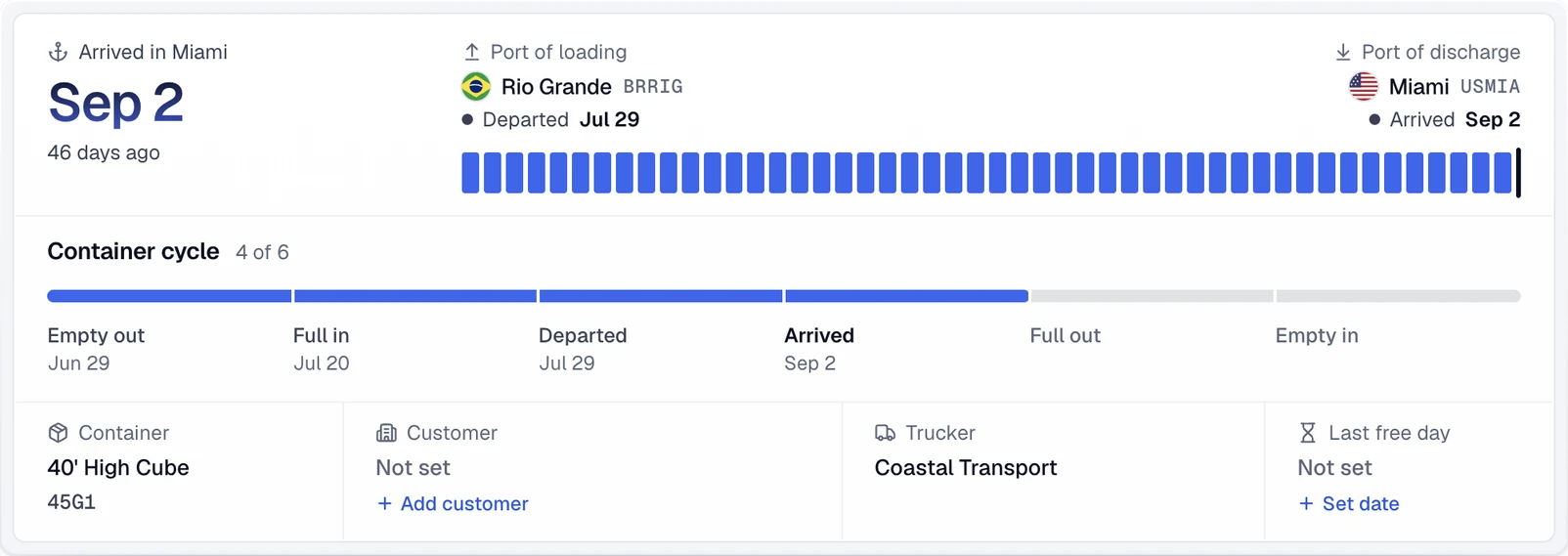
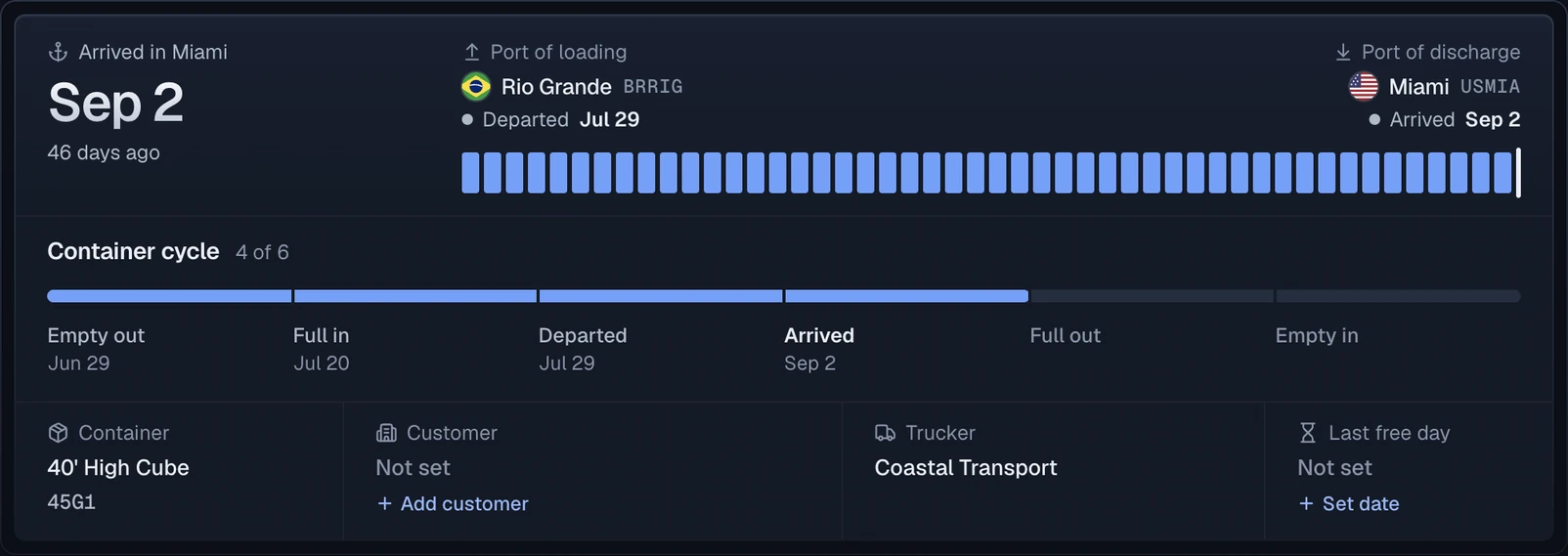
A container discharged at Savannah shows the port of discharge and the final destination as separate stops, so the move after the vessel stays on the same record.
Official sources
Questions
What should I know about Savannah before booking through it?
Savannah is operated by the Georgia Ports Authority, which runs Garden City Terminal as a single large contiguous container facility rather than splitting volume across many separate operators.
How do containers move inland from Savannah?
Its distinguishing feature is on-terminal rail moving containers toward Atlanta, Memphis and the wider Southeast, alongside a dense cluster of distribution warehousing built around the port.
What gets missed when tracking a Savannah container?
The single-terminal structure removes the "which facility" question that dominates Los Angeles or New York. What remains is the rail-versus-truck decision, and those two paths diverge immediately after discharge.
The vessel arrived in the US — why has my container not discharged?
Many East Coast services work several US ports in one rotation. If your discharge port is later in that rotation, the container stays aboard while the vessel works the earlier calls. Watching the discharge event rather than the first US arrival gives the real timing.
How much warning does an exam give?
Usually none in advance. An exam appears as a hold after arrival, and it can consume a large part of the free-time allowance. Seeing the hold as soon as it posts is the only practical way to re-plan around it.
Can I track a container by container number?
Yes. CargoScope is designed to help users track ocean containers by container number and monitor shipment visibility from one dashboard.